COVER STORY

EARTHQUAKES
EVERYDAY FEAR
and the Quiet Risk Beneath Bangladesh
The tremor lasted only a few seconds, but it unsettled an entire city. In apartments across Dhaka, ceiling fans swayed, cupboards rattled, and mobile phones lit up almost instantly with messages: Did you feel it? Was that an earthquake? Some people rushed toward stairwells. Others froze, unsure whether to move or wait. Children cried. Elderly parents were guided to chairs. And then, just as suddenly as it began, the movement stopped.
Within minutes, the city returned to its rhythm. Traffic resumed. Offices reopened. Tea stalls filled again. For many, the moment dissolved into a fleeting anecdote, something to be mentioned briefly before attention shifted back to work deadlines and daily errands. Yet beneath the surface calm lingered an unease that Dhaka knows well. Earthquakes in Bangladesh rarely arrive with devastation, but when they do come, even briefly, they expose a deeper vulnerability that tends to be forgotten once the ground falls silent again.
Bangladesh is an earthquake-prone country. This is not speculation or fear-mongering; it is a geographic reality shaped by tectonic forces far beyond human control. Recent tremors, combined with renewed analysis of seismic history, have prompted warnings from some experts that a large earthquake could occur at any time. What troubles many professionals is not the inevitability of an earthquake itself, but the uncomfortable truth that Dhaka, and Bangladesh more broadly, remains dangerously unprepared to face one.
Remembering Shaking Through Stories
In older neighborhoods of Dhaka, earthquakes live on through memory rather than measurement. Elderly residents recall stories passed down from parents who experienced the great Assam earthquake of 1950, how walls cracked, ponds rippled, and fear spread through communities unaccustomed to such movement. These stories are often recounted as moments of shock rather than lasting transformation, reminders of how fragile everyday life can suddenly become.
Younger generations remember more fragmented moments: a tremor during school hours that sent teachers scrambling, a chandelier swaying during a wedding ceremony, a sudden jolt in the middle of the night that left families awake long after the earth settled. These moments are unsettling but rarely decisive. They interrupt life without reshaping it.
As a result, earthquakes occupy an uneasy space in the public imagination. They are acknowledged as dangerous, yet treated as distant. Floods arrive every year, forcing communities to adapt through repetition. Cyclones follow a recognizable season, reinforced by early-warning systems and evacuation drills. Earthquakes, by contrast, feel irregular and unpredictable, making them easier to dismiss once the immediate fear fades.
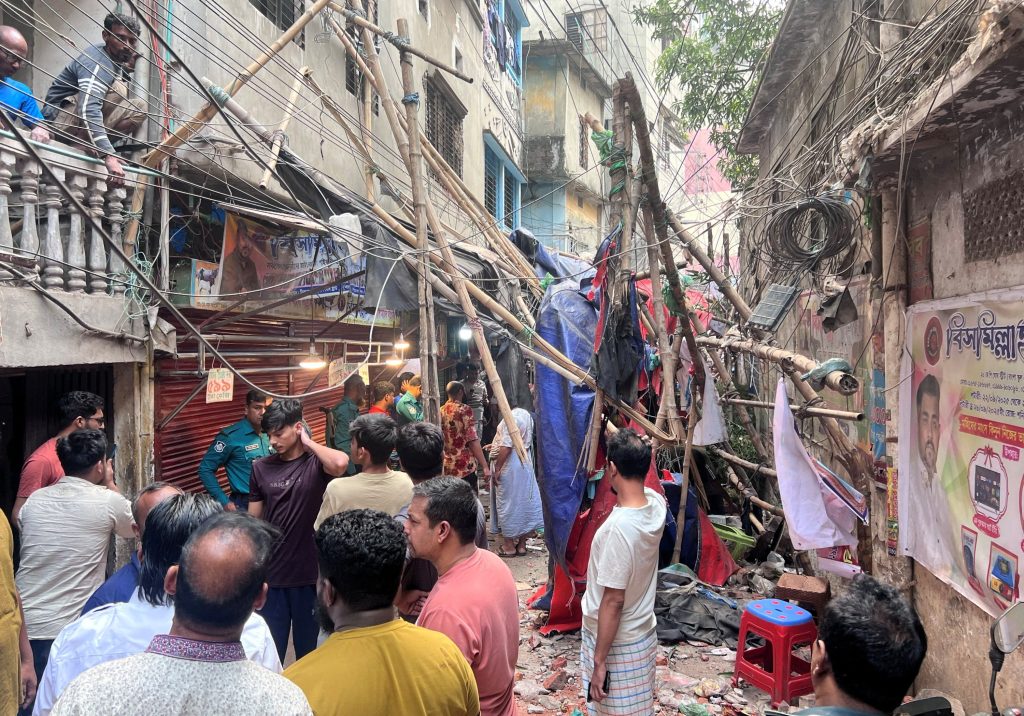
Residents stand in an alley after vacating their house next to a fallen scaffolding following an earthquake, Dhaka, Bangladesh, Nov 21, 2025.
But seismic risk does not diminish because it is infrequent. In fact, the most destructive earthquakes often strike after long periods of quiet, when preparedness has eroded and complacency has taken root.
The Science Beneath the Delta
Geologically, Bangladesh is far from stable. The country sits near a complex junction of tectonic plates that have shaped South Asia over millions of years. To the north, the Indian plate presses relentlessly against the Eurasian plate, forming the Himalayan range. To the east, interactions with the Burma plate generate seismic activity along active fault systems extending toward Bangladesh’s eastern regions.
Several of these faults lie uncomfortably close to major population centers. The Dauki Fault near the northern border, the Madhupur Fault beneath central Bangladesh, and fault systems in the east all pose credible threats. Long periods of inactivity along these faults do not signal safety. Instead, scientists warn, strain accumulates gradually, increasing the potential for a stronger release when it finally occurs.
Adding to this risk is the nature of the land itself. Much of Bangladesh, including Dhaka, is built on soft alluvial soil deposited by rivers over centuries. During strong earthquakes, such soil can amplify shaking or even liquefy, undermining foundations and causing buildings to fail. Structures that appear solid under normal conditions
may behave very differently under seismic stress.
These geological realities remain largely invisible in daily urban life. Buildings rise rapidly. Neighborhoods densify. The city expands upward and outward, often without fully accounting for what lies beneath its foundations.
A City Built Faster Than Safety
Dhaka’s transformation into a megacity has been driven by necessity. Millions migrate to the city for work, education, and survival, pushing housing demand to relentless levels. Construction responds accordingly, fast, dense, and often poorly regulated.
The result is an urban fabric marked by deep inequality. Reinforced concrete buildings stand beside aging masonry structures. Informal settlements grow without formal oversight. High-rise towers compete for skyline dominance, sometimes prioritizing floor area over structural integrity. Older neighborhoods with narrow lanes and closely packed buildings remain home to millions, even as infrastructure ages around them.
Decades of development that ignored or bypassed regulations have produced thousands of unsafe structures. Building codes exist, but enforcement has been inconsistent. Supervision is often weak. Material quality varies widely. The city has grown faster than its capacity to manage risk, creating layers of vulnerability that accumulate silently over time
Preparedness Gaps That Matter Most
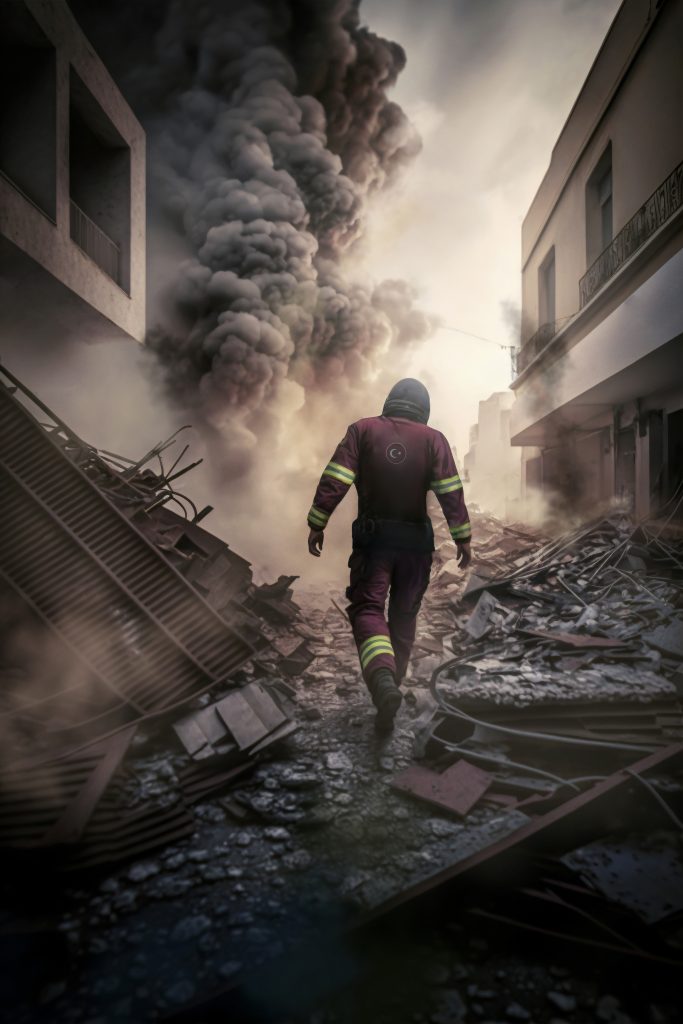
In a city of nearly 20 million people, Dhaka has only 19 fire stations. The number of registered volunteers nationwide stands at approximately 45,000, far too few to manage large-scale post-earthquake rescue operations. Emergency response capacity remains severely limited, particularly in dense neighborhoods where access is already constrained.
If major hospitals were to collapse in a large earthquake, there would be no alternative facilities ready to provide care. Bangladesh has not developed mobile hospitals or field ICU units that could be rapidly deployed. Even the logistics of managing mass fatalities, including ensuring dignified handling of bodies, remain largely unplanned.
These are not abstract concerns. They are structural weaknesses that would determine survival and recovery in the aftermath of a major earthquake.
Calm, Not Panic: What Experts Are Saying
At the same time, many senior engineers, architects, and researchers caution strongly against fear-driven narratives around earthquakes. They argue that panic itself can increase casualties, often turning manageable situations into dangerous ones. According to them, preparedness, not prediction, is the most effective way to reduce loss of life and injury.
These views were articulated at a recent roundtable discussion titled “Earthquake: Reality, Perception, and Strategies for Awareness,” organized by the Institute of Architects Bangladesh (IAB). The discussion brought together architects, engineers, geologists, urban planners, and disaster-management professionals. Rather than focusing on worst-case scenarios, the participants emphasized practical steps, professional responsibility, and public awareness.
Dr. Shamim Z. Bosunia, a renowned civil engineer and Emeritus Professor at the University of Asia Pacific, stressed that competent engineering and proper construction oversight are far more important than fear. He pointed out that many injuries during earthquakes occur not because buildings collapse immediately, but because people panic and make unsafe decisions. Rushing down staircases, jumping from balconies, or crowding exits during shaking often leads to serious injury or death. According to him, calm behavior, combined with structurally sound buildings, can significantly reduce risk.
Former IAB president and former Chief Architect Kazi Golam Nasir echoed this concern. He warned against
speculative forecasting and alarmist media narratives that attempt to predict the exact timing of a major earthquake. Such claims, he argued, distract people from what truly matters. Fear can cause confusion, helplessness, and inaction. Instead of spreading anxiety, he emphasized the need to build confidence through inspection, maintenance, and the identification of structurally vulnerable buildings. For him, hope grounded in preparation is more useful than fear rooted in uncertainty.
From a planning perspective, RAJUK Chief Town Planner Ashraful Islam offered a sobering assessment of Dhaka’s readiness. He highlighted the lack of reliable data on how many buildings in the city are structurally safe. He also pointed to the shortage of open spaces that could serve as emergency assembly areas. In addition, he warned that Dhaka lacks the capacity to manage the enormous volume of debris that would be generated by a major earthquake. Without advance planning, debris removal alone could paralyze rescue and recovery efforts.
Together, these expert voices convey a clear message. Earthquakes should neither be ignored nor sensationalized. The greatest danger lies not in uncertainty about when an earthquake will strike, but in failing to prepare for one.
Unequal Risk, Unequal Survival
Earthquake risk in Bangladesh is deeply unequal. Those living in poorly constructed buildings, working in overcrowded factories, or residing in older parts of cities face far greater danger than residents of newer, well-engineered developments. Yet these same populations often have the least power to demand safer conditions.
A garment worker may be aware that a factory building is unsafe, but refusing to work is rarely an option. A family in Old Dhaka may understand the risks posed by narrow staircases and aging structures, but financial limits and social ties make relocation difficult. A schoolteacher may worry about how students would respond during an earthquake, yet receive no training or guidance from authorities.
These examples show that preparedness is not only a technical issue. It is shaped by income, access, and power. Safety is often treated as a privilege rather than a right. As a result, the people most exposed to risk are often those least able to reduce it. Preparedness, in this sense, is social and political. It reflects whose lives are prioritized, whose neighborhoods receive attention, and whose risks are accepted as normal.
Everyday Preparedness Inside Buildings
Beyond infrastructure and governance, earthquake preparedness is also shaped by what happens inside buildings. How rooms are arranged, where furniture is
placed, and whether people know where to take shelter all influence survival during shaking. Even when buildings remain standing, unsecured interiors can cause serious harm.
Everyday objects such as bookcases, wardrobes, televisions, and glass tables can turn dangerous during earthquakes if they are not properly secured. Heavy furniture placed near beds, workspaces, or children’s play areas poses particular risk. In many earthquakes around the world, injuries occur not from collapsing buildings but from falling furniture and shattered glass.
Simple, low-cost measures can reduce this danger significantly. Anchoring shelves and cabinets to walls helps prevent them from toppling. Storing heavy items on lower shelves reduces the risk of falling objects. Moving fragile or glass furniture away from walkways and sleeping areas lowers the chance of injury. These choices may seem minor, but during an earthquake they can be life-saving.
Knowing where to shelter is equally important. Sturdy tables and strong interior corners can provide protection during shaking. International guidance promotes the Drop–Cover–Hold On approach: drop to the ground, take cover under strong furniture, and hold on until the shaking stops. Yet in Dhaka, few homes, schools, or offices clearly identify safe zones or practice these actions.
Public drills remain rare. Schools seldom conduct earthquake simulations. Offices focus on fire safety but rarely address seismic risk. Residential buildings lack signage or basic instructions. When the ground moves, people rely on instinct. In dense urban settings, instinct often leads to panic rather than protection
Governance Over Guesswork
Earthquakes cannot be predicted with certainty. What can be predicted, however, is the outcome of poor
governance. Weak enforcement, fragmented authority, and delayed investment in prevention turn natural hazards into human disasters.
Effective preparedness requires coordination across planning, construction, education, health, and emergency services. It demands regular building inspections, retrofitting of vulnerable structures, public drills, and continuous awareness campaigns. Most importantly, earthquake safety must be treated as part of everyday urban governance, not as a temporary concern after tremors.
Preparedness also requires space. Open grounds for assembly, emergency access routes, and temporary shelter areas are essential. In Dhaka, where public space has steadily disappeared, this poses a serious challenge. The loss of playgrounds and open fields is not only an urban design failure; it is a failure of disaster planning.
Living With the Ground We Have
Bangladesh cannot move away from its fault lines. It cannot stop tectonic movement. What it can do is decide how its cities live with uncertainty. Earthquake safety is not a single project or policy. It is an ongoing process that requires learning, enforcement, accountability, and public trust. Development without resilience is fragile, no matter how impressive it looks.
The next earthquake felt in Dhaka may again pass without major damage. Or it may not. What will determine the outcome is not the strength of the shaking alone, but the choices made long before it begins. Until preparedness becomes routine rather than reactive, Bangladesh will continue to live with a quiet risk beneath its feet, one that waits patiently, unseen, and unchanged by how busy the city above it becomes.