SHOW REVIEW
Bangladesh Architects and Engineers Rally
for Earthquake Preparedness
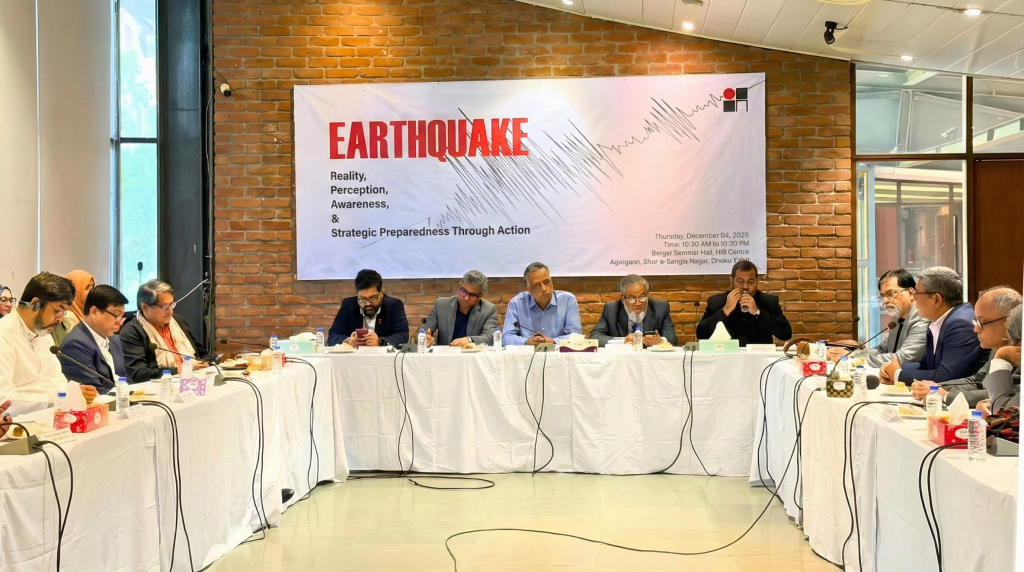
The Institute of Architects Bangladesh (IAB) convened a high-level roundtable in Dhaka to address the nation’s earthquake vulnerability. Experts from architecture, engineering, urban planning, and government highlighted critical gaps in building safety, emergency response, and regulatory oversight, while calling for evidence-based preparedness, retrofitting, and community awareness programs to safeguard lives in Bangladesh’s most at-risk areas.
The Institute of Architects Bangladesh (IAB) recently hosted a high-level roundtable discussion titled “Earthquake: Reality, Perception, Awareness & Strategic Preparedness through Action” at the IAB Center in Agargaon, Dhaka, bringing together leading experts to address Bangladesh’s growing vulnerability to seismic disasters.
The urgency of the discussion was underscored by recent seismic activity in the country, including a 5.7-magnitude earthquake on November 21 near Madhabdi, Narsingdi, which claimed 10 lives and injured over 600 people. Between 2021 and 2024, Bangladesh experienced 39 earthquakes, 11 of which were near Dhaka, highlighting the capital’s acute exposure.
The session featured an array of voices from architecture, engineering, urban planning, and government. Senior IAB Fellows, including Iqbal Habib, Kazi Golam Nasir, Asifur Rahman Bhuiyan, Dr. Qazi Azizul Mowla, and Patrick D’ Rozario, shared architectural and urban planning perspectives. Civil engineering insights came from Professor Dr. Shamim Z Bosunia, Professor Dr. Raquib Ahsan, Abdullah Al Hossain Chowdhury, and Shakhawat Hossen, while urban planning and policy perspectives were represented by Md. Ashraful Islam, Dr. Mohammad Giyasuddin Haydar, Professor Dr. Badruddoza Miah, Golam Mostafa, and Lieutenant Colonel Mohammad Tajul Islam Chowdhury.
The roundtable was chaired by IAB President Architect Professor Dr. Abu Sayed M Ahmed, with Vice President Architect Nowajish Mahbub moderating and General Secretary Architect Dr. Masud Ur Rashid delivering the welcome address.
Experts emphasized the role of proper structural supervision and compliance in mitigating earthquake risks. Professor Shamim Z Bosunia advised calm and precautionary action during seismic events:
“If those skilled in structural engineering do their work properly, and if construction supervision is done correctly, there is no reason to fear. Trust in Allah. Take shelter safely, stay alert, and many lives can be saved through such precautions alone.”
Architect and urban planner Iqbal Habib stressed that while earthquakes cannot be prevented, the damage can be minimized. He highlighted gaps in building approvals
and called for regulatory authority formation, block development, and implementation of TDR measures to reduce risks from fire hazards, gas leaks, and poor construction.
Professor Raquib Ahsan pointed out that not all civil engineers are trained in earthquake-resistant design, urging continuous professional development and collaboration between architects and engineers to enhance building safety.
Former IAB president Kazi Golam Nasir warned against spreading fear through unscientific predictions, advocating instead for immediate practical measures: “Identify vulnerable buildings, widen narrow roads for emergency access, retrofit critical government infrastructure, secure free-standing furniture, ensure proper soil testing, and clearly mark emergency exits.”
IAB President M. Sayed Ahmed reaffirmed the institute’s commitment to national safety: “We want to save the country and protect everything in it. Through post- disaster planning, we can recommend actions to the government and ensure collective survival.”
The roundtable revealed critical gaps in Dhaka’s disaster preparedness, including only 17 fire stations serving over 30 million residents. Experts called for building retrofits, stricter codes, community drills, and integration of disaster management into school curricula, emphasizing evidence-based strategies over misconceptions.
The session concluded with a unified commitment to forward actionable recommendations to policymakers and strengthen Bangladesh’s preparedness against future earthquakes, focusing on safeguarding lives and minimizing losses in the country’s most vulnerable areas.